
Getting press coverage for your indie game often feels unpredictable and, honestly, a lot of the time it is. You send emails, wait, and most of the time nothing happens. After working on multiple indie game PR campaigns, I have seen plenty of non-replies and moments where nothing seemed to land. I have tried different angles, different approaches, and sometimes something worked once and then did not work again. There are always things you cannot control, like how busy journalists are or what their current content plans look like. But there is still a lot you can control on your side.
I want to share my learnings through this guide, which breaks the process down into a simple step by step system focused on what actually improves your chances of getting coverage. Before reaching out to press, you need a few key things in place. This is where most indie game PR efforts fail, not because the game is not interesting, but because the foundation is not clear yet.
Think of the next steps as setting the table before inviting media in. If everything they need is already in place and looks delicious, they are much more likely to sit down and dig in.

Step 1: Define your game’s angle
Most developers explain their game. Press looks for something that can be understood instantly and repeated easily. Your game’s angle is the one clear hook that makes someone immediately understand why your game is interesting. It is the part people remember, repeat, and turn into a headline. It is not your genre or a full description, but the specific idea that makes your game stand out.
Why it matters?
If your idea is not clear in one sentence, everything else in your indie game marketing and game PR strategy becomes harder. Journalists are not going to figure it out for you. If the concept is not obvious within seconds, it gets ignored.
What to do?
Write one sentence that clearly shows:
- What the player actually does moment to moment
- What makes this different from similar games
- What creates tension, stakes, or curiosity
- Saying “roguelike,” “platformer,” or “city builder” does not explain why your game is interesting.
Example
Too vague: “A city builder with survival elements”
Stronger: “A city builder where your citizens can abandon or betray you if resources run low, forcing you to balance growth with constant crisis management”
Pro tip: If your description sounds like it could apply to many games, it is not specific enough yet. A strong angle is the foundation of effective indie game PR and makes every part of your press outreach easier.
Step 2: Prepare your press kit
Once your angle is clear, everything else should support it. Your indie game press kit is where journalists quickly decide if your game is worth covering.
Why it matters?
If someone clicks your link and does not understand the game within seconds, they may leave. Most press does not spend time figuring things out, especially when they are reviewing multiple pitches or working on tight deadlines. A clear and well structured game press kit makes your game press outreach significantly more effective.
What to do?
Create a simple, easy to scan press kit that clearly reflects your angle:
- Include 1 to 2 strong key art images and 5 to 10 current screenshots that show actual gameplay, core mechanics, environments, and overall tone
- Add your current trailer or gameplay video, plus a downloadable version if possible
- Include a short game info / fact sheet with your hook, key features, platform, release timing (if revealed publickly), studio or solo developer info, and contact details
- Add your game and studio logos in high resolution, ideally with transparent versions
- Make sure everything is easy to download and clearly labeled, without extra logins or unnecessary steps
- Keep it all in one clean press kit page or clearly structured folder, and update it as the game changes
If you want the full breakdown, check out my guide on what to include in an indie game press kit or download a checklist.
Pro tip: Your screenshots should answer one simple question without any text: what do I do in this game? Also, assume no context. The person opening your press kit may know nothing about your game, so your visuals and description need to stand on their own.
Optional: Prepare a press release
A press release is not required for every indie game PR campaign, but it can be useful when you have clear news to share.
Why it matters?
A press release gives journalists a clear, structured overview they can quickly scan and reference. More importantly, it gives them an actual reason to cover your game. If you have a real news hook, such as your game announcement, a demo launch, a release date, or another meaningful milestone, the press release packages that news in a way media can easily understand and use. On your side, it also helps clarify your indie game PR messaging and keeps your outreach consistent across different outlets.
What to do?
Prepare a short, clear press release only when you have something newsworthy to share, such as announcing your game, revealing a demo, confirming a release date, or launching. Keep it focused and easy to scan:
- Write a strong headline that reflects your game’s angle
- Start with a short introduction that clearly explains what the game is and what the news is about
- Highlight a few key features or what makes it stand out
- Include essential details like platform and release timing, but only if it’s time to reveal them now.
- Add links to your indie game press kit for more information
If you need help, check out my guide on how to write a press release for your indie game, or use the ready-made template.
Pro tip: Do not rely on a press release alone. It supports your outreach, but your pitch email and subject line is what actually gets someone to open and consider covering your game. We will get to that in the next steps. For now, focus on building a strong and relevant target list.
Step 3: Build a targeted media list
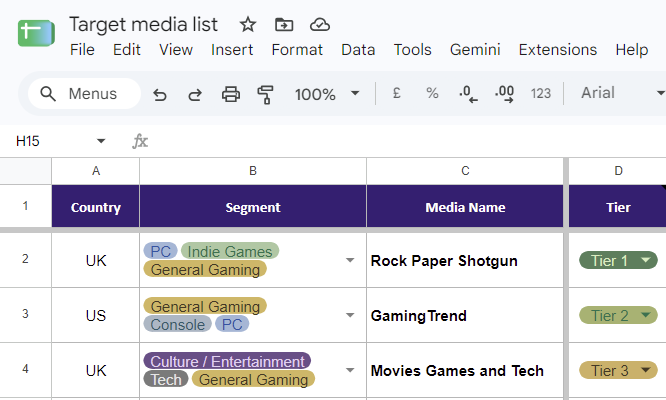
You need a decent sized contact list, but it has to be relevant. I have worked with very long lists before, mainly because I had a large pool of gaming contacts and was not always sure who would be interested in the games I was promoting. Over time, one thing became very clear: if there is no obvious connection between the outlet and your game, the chances of coverage are very low. A bigger list helps, but only when you can still justify why each contact is on it.
Why it matters?
Sending emails to the wrong people wastes time and lowers your chances. Journalists quickly ignore pitches that are not relevant to what they cover. Relevance is what gets replies in game press outreach.
What to do?
Aim for as many relevant contacts as you can reasonably find. A highly relevant journalist who actively covers your genre, platform, or type of announcement may still only have a rough 10 to 20% chance of covering a cold pitch, while loosely relevant contacts can be much lower. As a simple example, if you have a well targeted list of 50 relevant contacts, around 5 to 10 pieces of coverage can be a realistic outcome. Depending on the strength of the game, the news hook, timing, relationships, and how busy the media are, it could be more or less.
- Search for games similar to yours
- Open articles covering those games
- Note the journalist name and outlet
- Add a short note like “covered [Game X]” for future reference
- Prioritize:
- Indie-friendly outlets
- Writers who cover your genre or style of game
- Journalists who have recently covered similar titles If unsure how to build a list, see the indie game media list guide.
For a more in depth breakdown, check out my separate guide on building an indie game media list, including what information to collect, how to structure it, and how to keep it useful for future campaigns.
Pro tip: If someone has already covered a similar game, they are much more likely to care about yours. A smaller, highly relevant game media list will perform better than sending emails to hundreds of random contacts. Having said that, building a large relevant list should be the goal.
Step 4: Write a pitch that is easy to understand
Once the foundations are in place, you can move into outreach. At this point, your goal is not to reach as many people as possible, but to reach the right people with a clear and relevant message. Most emails are too long. Yours should be clear within a few seconds. If the core idea is not understood immediately, the email is often skipped, no matter how good the game is. But clarity alone is not enough. Your pitch also needs to make the game sound interesting enough to click on.
Why it matters?
Journalists scan quickly and go through a high volume of emails. If they do not understand what your game is, why it stands out, and why it might be relevant to them right away, they move on. A good pitch is not there to explain everything. Its job is to make someone instantly understand the game and want to learn more. That is one of the most important parts of effective game press outreach.
What to do?
- Write a clear and interesting subject line that highlights the most interesting part of your game
- Start with relevance by mentioning something they covered or why your game fits their interests
- Lead with the most interesting or distinctive part of your game
- Describe what the game is in two or three clear sentences.
- Explain what makes it worth paying attention to
- Avoid long introductions, unnecessary background, feature lists, or overexplaining
- Add key art and 1 to 2 strong gameplay screenshots directly in the email for an immediate visual impression. Compress or optimize them first so the email stays lightweight and delivers reliably.
- Include a link to a short gameplay trailer (YouTube preferred) for a deeper look
- Include a link to your indie game press kit
- Include demo or build access if available
Example
Subject: Early demo access: Can you save lives in this hospital sim?
Hi [Name],
I saw your recent coverage of [Game], and thought this might be a good fit. Since you cover similar simulation games, I wanted you to be among the first to check it out.
Night Shift is a simulation game where you play as a doctor working late hospital shifts, making life or death decisions with limited information. Each patient brings a different case, from routine checkups to critical emergencies, and your choices shape what happens next. As the night gets busier, cases become more complicated, time gets tighter, and you have to decide who to prioritize while managing staff, treatment rooms, and limited resources.
We will be releasing a public demo on 2nd of June, so I wanted to share early access in case you would like to check it before it goes public.
You can access the demo here: [key/link]
Press kit: [link]
Gameplay trailer: [link]
Happy to share a key or more details if useful.
Thanks a lot,
[Name]
[Add key art and some screenshots]
Pro tip: Before sending, read your email once or twice and remove anything that does not help someone understand or care about your game. Double check if the links are working, and if the key is correct.
Step 5: Personalize your outreach
Personalization does not need to be complicated, but it should be intentional.
Why it matters?
Generic emails are easy to ignore, especially in game press outreach where journalists receive many similar pitches. I have seen my pitches perform better just by mentioning a small, relevant detail.
What to do?
Add one short, relevant line that shows why you are reaching out to them specifically:
- Reference a recent article they wrote
- Or mention a similar game they covered
- Or that you have seen they have been covering a specific genre
- Keep it to one or two sentences max, make sure it directly connects to your game, and you can shortly mention similarities and how it is different and unique.
- Avoid over-explaining or trying too hard. The goal is to show relevance, not to impress.
Example
“I saw your recent piece on [Game], and this felt like a good fit.”
“I saw you wrote about [Game], and thought this could be up your alley.”
“Since you’ve covered similar [simulation] games, I thought this might be worth a look.”
Pro tip: Over-personalizing can feel forced and unnatural. In indie game PR, simple and relevant almost always works better than long or overly detailed messages.
Step 6: Send at the right time
Even a good pitch needs context.
Why it matters?
Without a clear reason to cover your game now, it is easy for journalists to ignore your email, even if the game itself is interesting. Timing is often the difference between no replies and real coverage in indie game PR. The same pitch can perform very differently depending on when it is sent.
What to do?
Send your pitch when you have something meaningful to share:
- A demo launch
- Your Steam page going live
- A release date announcement
- Participation in an event or festival
- A new trailer that clearly shows gameplay
- A major update or new feature worth highlighting
- An announcement of a publisher or partnership
- A closed beta or playtest opening
- Console or platform confirmation
- A significant milestone (for example, “1.0 release after early access”)
- An award, nomination, or festival selection
- A strong story angle (for example, development story, unique inspiration, or unusual concept)
These moments give your game press outreach a clear hook and make it easier for media to justify covering your game. Avoid reaching out too early without a clear update or too late when the moment has already passed.
Pro tip: If you are unsure whether to send, ask yourself: why would someone write about this today? If there is no clear answer, it is better to wait.
Step 7: Follow up once or twice
No reply does not mean no interest.
Why it matters?
Emails get buried, especially in busy inboxes. A follow-up brings your pitch back to the top and gives it another chance to be seen. Well timed follow-up often gets replies that the first email did not.
What to do?
Keep it simple and respectful:
- Wait a a couple of days before following up
- Send a short message that references your original email
- Do not add new information unless you actually have an update. The goal is to remind, not to restart the conversation
Example
“Wanted to circle back in case my last email got buried. Happy to resend anything you need.”
“Just checking in to see if you had a chance to look at the demo.”
“A quick follow up on the demo key I shared earlier. It should still be active if you’d like to check it out.”
Pro tip: Do not over-follow up. In indie game PR, one follow-up is usually enough. Two can be acceptable if there is a meaningful update, such as a demo release, new trailer, or confirmed date.
Step 8: Review and adjust
If nothing happens, do not just send more emails.
Why it matters?
More volume does not fix the wrong problem. In indie game PR, sending more pitches without changing anything usually leads to the same result. Small adjustments often have a bigger impact than increasing outreach. It is also normal for good outreach to get no replies. Coverage is not guaranteed, but improving these elements consistently increases your chances over time.
What to do?
Take a step back and review what might not be working:
- Is your angle clear and easy to understand?
- Is your pitch too long or not getting to the point fast enough?
- Are you targeting the right journalists and outlets?
- Do you actually have something newsworthy to share?
- Do you actually have something newsworthy to share?
Try improving one element at a time instead of changing everything at once. This makes it easier to see what is actually making a difference in your game press outreach.
Pro tip: Small improvements here often change results more than sending more emails. Focus on clarity, relevance, and timing before increasing volume.
Final thoughts on indie game PR
Press outreach becomes much easier once you treat it as a system and start with a clear foundation. A clear idea, relevant contacts, and the right timing are often enough to start seeing results. Results rarely come from one email or one moment. They build over time as your message becomes clearer, your targeting improves, and your timing aligns better with real opportunities. If something is not working, do not send more emails. Step back, adjust your angle, your pitch, or your targeting, and try again.