
If you have already built your indie game media list, you are ahead of most developers. You now have a list of journalists, creators, and outlets that could potentially cover your game, along with your base pitch, press release, or core message. But building the list and preparing your materials is only the first step. The real challenge comes next. Deciding who is actually worth pitching, what angle makes sense for them, and how to adapt your pitch without it feeling generic or off target.
In my previous guide on how to build an indie game media list, the focus was on finding the right contacts and organizing your outreach. That step helps you avoid random pitching and gives you a solid foundation. This guide focuses on refining your outreach before you hit send.
I used to spend hours researching journalists’ coverage, and it was difficult to keep track of everything alongside all the other tasks involved in a campaign. Now with such advanced AI tools available, it really helps to speed that process up and make sure you are actually contacting the right person with the right approach. The process now has become more simple, and once you get used to it, it takes around five minutes per contact.
Here are 4 simple on how to use AI to research journalists faster.

Step 1: How to use AI to research journalists’ coverage
Before using AI, I still start with a quick manual check. I open the journalist’s author page and skim a few recent articles, usually three to five. The goal is not deep analysis, just to get a basic sense of what they cover, how they write, and what kind of content they publish. At this stage, you can already skip some contacts if it is obvious right away that they are not relevant to your game.
After getting a quick sense of the journalist, I usually take screenshots of their profile and recent articles. I may also open a few pieces and copy the text into an AI like ChatGPT, Claude, or another tool you prefer. If the tool can access the articles directly, I also give it the links and ask it to review the journalist’s recent coverage. Sometimes it may not be able to access them because of paywalls, login requirements, site restrictions, or technical limitations, so screenshots or copied text are a useful backup.
When I point the AI to the journalist directly, I keep the prompt simple.
Prompt:
Based only on the material I shared, look at this journalist’s most recent coverage. What patterns do you see in the types of games they cover, the themes they return to, and the tone or angles they tend to use?Do not make assumptions or invent preferences that are not supported by their actual work. Give me only the points that would help me evaluate whether my game is genuinely relevant to this journalist
Follow up prompt:
Based on these patterns, what kinds of games, stories, or angles would likely interest this journalist, and what would they probably be less interested in? Base this only on the coverage we just reviewed.
This is where the research becomes more useful. Instead of just knowing what they cover, you start understanding what actually seems to drive their interest. You might notice a preference for emotional storytelling, personal developer journeys, certain gameplay experiences, or specific types of stories that appear repeatedly in their work.
That also changes how you think about your own game. Instead of asking what your game includes, you start asking which part of it is actually relevant to this particular journalist.
You do not need a perfect prompt here. Even a simple question is enough to get a useful summary and quickly understand whether you are on the right track.
Step 2: Validate if your game is actually a fit based on their interests
With that context, I bring in the game itself. At this point, you already understand what the journalist tends to cover and what kind of stories they respond to, so the question becomes simple. Does your game actually belong here.
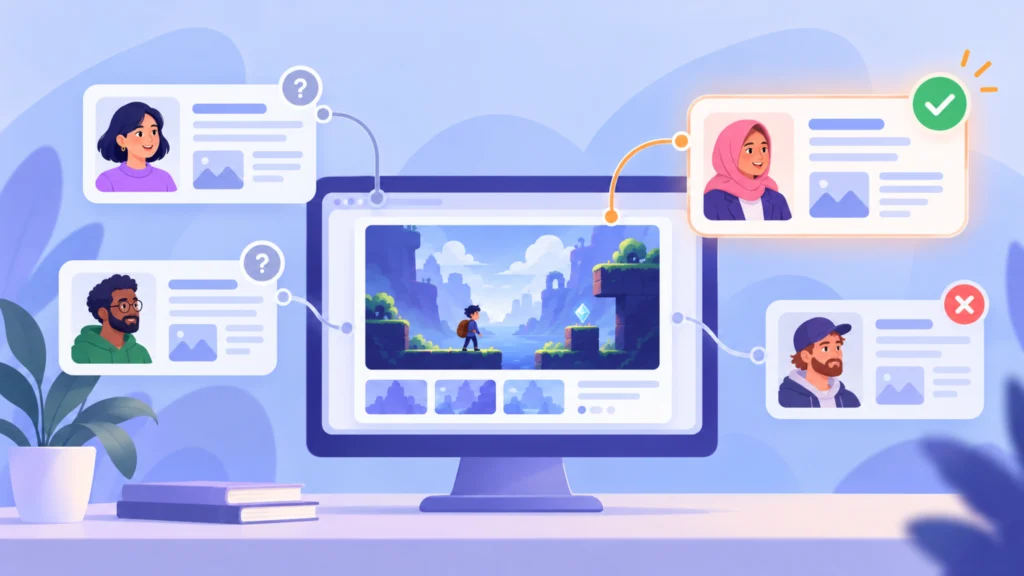
Now If you already have a project set up in your AI tool with the full context of your game, you can go straight to the next prompt. If not, I recommend creating one so you do not have to explain the game from scratch every time. Give the AI as much relevant information as possible about your game, including its features, story, positioning, development background, and potential angles. You never know which detail might be especially interesting to a particular journalist or media contact.
Prompt:
Based on this journalist’s coverage, is my game a strong fit for them? If yes, what angle should I focus on? If no, briefly explain why. Base your answer only on the coverage we reviewed.
This is one of the most useful steps when learning how to pitch game journalists effectively because it forces a clear decision. Not every contact on your list should be pitched, even if they broadly cover indie games.
Sometimes the connection is weak, the genre does not match, or the journalist focuses on a different type of story. When that happens, the best move is to skip and move on. It is also important not to push for a positive answer. If you ask in a way that assumes a fit, the output will often try to justify one. Keeping the question neutral and asking it to rely only on the coverage you reviewed makes it more likely to highlight gaps or mismatches.
When there is a good fit, the response usually gives useful direction. It might point you toward emotional storytelling, a specific theme, or a developer angle rather than gameplay systems. At that point, you are no longer guessing. You have a clear direction for how to position your game for that specific journalist.
Step 3: Personalize your message
This is where many game PR outreach emails start to break. Personalization is often treated as a quick sentence added at the top, but if it is not grounded in something real, it tends to feel empty.
At this point, you already know what the journalist covers and what kind of stories they respond to, so the goal is to turn that into a short, natural opening that explains why you are reaching out to them specifically.
Prompt:
Write two short personalized opening lines for my pitch based on this journalist’s past coverage and the information you have about my game. Reference something specific from their work only if there is a genuine connection. If there is no clear connection, do not force one or add generic praise. Instead, suggest what I should highlight from my game to make the pitch more relevant to their interests.
The output does not need to be perfect. You are not looking for something to copy directly, just a starting point that reflects the right direction. In most cases, a simple reference to a recent article or the type of games they cover is enough to make the message feel relevant.
Follow up prompt:
Based on this research and the information you have about my game, write the full outreach pitch and subject line. Keep it concise, lead with the most relevant angle, explain the game clearly, and include the key call to action. [Add any specific details you want the pitch to include.] Do not invent details or force personalization.
This is also the step where you need to be careful. AI can sometimes invent details or stretch connections to make the personalization sound better than it actually is. I always take a few seconds to check that the article exists and that the reference makes sense in context. It is a small step, but it protects your credibility and keeps the personalization grounded in something real.
Step 4: Make the final call
Before moving forward with this contact, I pause for one final check. At this point, you already know what the journalist covers, what they seem to respond to, and how your game might fit.
Read the pitch again and ask yourself whether the connection actually makes sense. Even if the fit is not perfect, it can still be worth reaching out. You never really know what might catch someone’s interest at that particular moment.
What matters is that you do not force the personalization or make claims that are not supported by their coverage. I also like to quickly edit the AI-generated pitch myself before sending it, even if it is already good. A small human touch can make the message sound more natural, more like you, and less like something generated from a template.
A useful final question is: Does this sound like something I would actually send to this person? If not, adjust the wording, simplify anything that feels forced, and make sure the angle still makes sense.
A quick note on using AI to research journalists
AI is helpful in this process, but it should not replace your judgment. It works best as a way to organize information, highlight patterns, give you ideas, and challenge your assumptions. It can also misread tone, overgeneralize, or suggest connections that are not really there.
A quick skim of the journalist’s work is still important. Even a couple of minutes of manual checking adds context that AI alone cannot fully capture. The goal is to combine both, not rely entirely on one. That is the actual value of learning how to use AI to research journalists. Not just writing pitches faster, but understanding how relevant a contact is and what approach might work best for them.
Subscribe to our newsletter to get your free Target Media Template, plus weekly practical PR tips and resources to help you promote your indie game.